Showing posts with label Heart friendly. Show all posts

Monday, August 17, 2026

The Ultimate Guide to Traditional Oils: Safflower, Coconut, Sesame, Mustard & Castor


Traditional Oils: A Return to India's Natural Heritage

For generations, Indian households have relied on naturally processed oils for cooking, traditional wellness practices, hair care and skincare. Long before modern refining methods became common, families extracted oil from seeds and nuts using traditional techniques that focused on preserving the natural character of the oil.

Today, there is renewed interest in traditional oils, ghana-pressed oils and naturally processed cooking oils.

From the nutty character of sesame oil to the distinctive aroma of mustard oil and the versatility of coconut oil, each traditional oil has its own place in an Indian household.

At Tirupati Oil Ghana, our philosophy is simple: respect traditional oil-making methods and bring naturally processed oils to modern families.

1. Safflower Oil – Kusumba / Kardi Oil

Safflower oil, commonly known in parts of India as Kusumba or Kardi oil, has a long history of cultivation and use.

Naturally processed safflower oil is valued for its mild character and its fatty-acid profile. It can be used as part of a balanced cooking routine, depending on the variety and processing method.

Why choose safflower oil?

Naturally processed: Traditional extraction methods can help retain the characteristic flavour and aroma of the oil.

Unsaturated fats: Safflower oil contains predominantly unsaturated fatty acids, making it a popular choice among people looking for alternatives to heavily refined cooking oils.

Vitamin E: Safflower oil naturally contains vitamin E, although the exact nutritional composition depends on the variety and processing.

Everyday cooking: Its relatively mild flavour makes it suitable for many Indian dishes.

For families searching for natural safflower oil in Kalaburagi, choosing a trustworthy producer and checking the product label, processing method and food-grade certification is important.

2. Coconut Oil – A Traditional Household Favourite

Coconut oil has been part of Indian kitchens and personal-care traditions for generations.

Its distinctive aroma and flavour make it particularly popular in South Indian cooking, while its traditional use extends to hair and skin care.

Why coconut oil remains popular

Cooking: Coconut oil can be used for selected cooking and baking applications.

Hair care: Coconut oil has a long-standing place in traditional Indian hair-care routines.

Skin care: Many people use coconut oil as a simple moisturising oil for dry skin.

Versatility: A single bottle can have multiple traditional household uses, depending on whether it is food-grade or intended specifically for personal care.

For everyday use, always choose an oil specifically labelled for its intended purpose.

3. Sesame Oil – Tila Taila

Known traditionally as Tila Taila, sesame oil occupies an important place in Indian food culture and Ayurveda.

The Ministry of AYUSH has included traditionally used oils such as sesame, mustard and coconut among oils that may be used in cooking as part of a healthy diet.

Sesame oil has a naturally rich aroma and distinctive nutty taste that works particularly well with many Indian recipes.

Traditional uses of sesame oil

Cooking: Sesame oil is widely used in Indian cooking, pickles, tempering and regional preparations.

Traditional wellness: Sesame oil has been used in several Ayurvedic practices for generations.

Personal care: Sesame oil is also traditionally used for massage and other household wellness practices.

Oil pulling: Sesame oil has also appeared in traditional oral-care practices. The Ministry of AYUSH describes sesame or coconut oil as options for traditional oil-pulling practices.

If you enjoy the traditional flavour of Indian cooking, sesame oil is one of the most versatile oils to keep at home.

4. Mustard Oil – Sarshapa Taila

Mustard oil, traditionally known as Sarshapa Taila, is recognised by its strong aroma, pungent flavour and distinctive character.

It has been a staple in many Indian regional cuisines, particularly in northern and eastern parts of the country.

Traditional uses of mustard oil

Indian cooking: Mustard oil is commonly used for tempering, pickling, marinades and regional recipes.

Distinctive flavour: Its pungent character can add depth to traditional dishes.

Traditional wellness: Mustard oil has also been used traditionally in massage and personal-care practices.

Because mustard oil has a strong flavour, it is particularly suited to dishes where its distinctive taste is part of the recipe.

5. Castor Oil – Eranda Taila

Castor oil, traditionally known as Eranda Taila, is different from the four cooking oils discussed above.

It has a long history of traditional and personal-care applications and is particularly well known for its characteristic thick texture.

Castor oil should not automatically be treated as a regular cooking oil. Its use depends on the product specification and intended purpose.

Traditional uses of castor oil

Personal care: Castor oil is commonly used in traditional hair and skin-care routines.

Traditional wellness: Castor oil has a long history of use in traditional systems of medicine.

Laxative use: Castor oil is also recognised medically for its laxative properties, but oral use should follow appropriate product directions and medical guidance. The U.S. FDA recognises castor oil among ingredients used as stimulant laxatives.

Always check the label before using castor oil internally, and do not assume that a cosmetic-grade product is suitable for consumption.

Traditional Oil vs Refined Oil: What Should You Look For?

The debate is not simply about whether one oil is "good" and another is "bad."

What matters is the quality of the raw material, processing method, freshness, storage, food-grade standards and how the oil is used.

When purchasing traditional or wood-pressed oils, look for:

  • Clearly listed ingredients
  • Appropriate food-grade certification for edible oils
  • Transparent information about the extraction process
  • Proper packaging
  • Manufacturing and expiry information
  • A trustworthy manufacturer
  • Correct storage instructions

Most importantly, remember that oil is still a calorie-dense food. A balanced diet and appropriate portion sizes matter regardless of the type of oil you choose.

Why Traditional Oil-Making Still Matters

Traditional oil extraction is more than an old-fashioned process. It represents a connection between agriculture, craftsmanship and Indian food culture.

At Tirupati Oil Ghana, we believe traditional methods deserve a place in modern households when they are combined with proper hygiene, quality control and responsible food processing.

Our goal is to bring that traditional character to families looking for natural oils in Kalaburagi and across Karnataka.

Which Traditional Oil Should You Choose?

There is no single oil that is perfect for every purpose.

Safflower oil: A mild option for everyday cooking.

Coconut oil: Popular for cooking and traditional hair and skin care.

Sesame oil: Excellent for traditional Indian recipes and regional cooking.

Mustard oil: Ideal when you want the strong flavor associated with traditional Indian cuisine.

Castor oil: Primarily suited to specific traditional, personal-care or medicinal applications rather than general everyday cooking.

The best choice depends on your recipe, dietary needs, intended use and personal preference.

Frequently Asked Questions

Is wood-pressed oil the same as cold-pressed oil?

The terms are often used to describe oils extracted using relatively low-heat mechanical methods, but processing practices can vary between manufacturers. Always check the product's actual processing description.

Is safflower oil good for cooking?

Safflower oil can be used as a cooking oil, and its mild flavour makes it suitable for many dishes. Its nutritional profile varies depending on the safflower variety and processing method.

Can coconut oil be used for cooking?

Yes. Food-grade coconut oil is commonly used in cooking and baking and is particularly popular in many South Indian recipes.

Is sesame oil traditionally used in India?

Yes. Sesame oil has a long history in Indian cooking and traditional practices and is known as Tila Taila in Ayurveda.

Is mustard oil suitable for Indian cooking?

Mustard oil is traditionally used in many Indian regional cuisines, particularly for pickles, tempering, marinades and strongly flavoured dishes.

Can castor oil be used as cooking oil?

Castor oil should not be treated like ordinary edible cooking oils. Use it only for purposes specified on the product label. Oral medicinal use should follow appropriate directions and professional advice.

Bring Traditional Oil Back to Your Kitchen

The renewed interest in traditional oils reflects something simple: many Indian families are rediscovering the value of familiar ingredients and traditional food practices.

Whether you choose safflower oil, coconut oil, sesame oil, mustard oil or another traditional oil, focus on quality, appropriate use and trustworthy sourcing.

At Tirupati Oil Ghana, we continue to honor traditional oil-making while maintaining the quality standards expected by today's families.

Traditional roots. Natural oils. Quality you can trust.

Tirupati Oil Ghana

For enquiries and orders:

📞 +91 9739888837
📞 +91 8123757372

Choose natural. Choose tradition. Choose quality.

Friday, July 31, 2026

Discover Pure Safflower Oil in Kalaburagi: The 4,000-Year-Old Secret of Tirupati Oil Ghana

Discover Pure Safflower Oil in Kalaburagi: The 4,000-Year-Old Secret of Tirupati Oil Ghana


If you are searching for pure, chemical-free cooking oils that support your family's health without compromising on taste, the secret lies in ancient agricultural wisdom. At Tirupati Oil Ghana, located right here in Kalaburagi, Karnataka, we are Discover Pure Safflower Oil in Kalaburagi: The 4,000-Year-Old Secret of Tirupati Oil Ghana**


If you are searching for pure, chemical-free cooking oils that support your family's health without compromising on taste, the secret lies in ancient agricultural wisdom. At **Tirupati Oil Ghana**, located right here in **Kalaburagi, Karnataka**, we are dedicated to providing our community with premium, naturally extracted oils . Under the trusted guidance of **Mr. Kalaskar**, we proudly bring you the finest groundnut, coconut, sesame, and our specialty: pure safflower (*kusumba*) oil.


Here is why making the switch to our **cold-pressed Ghana oil in Kalaburagi** will transform your daily cooking and long-term wellness.


**The Ancient Heritage of Safflower (*Kusumba*)**

Safflower is not just another cooking ingredient; it is a remarkable **4,000-year-old crop** with deep roots in human history and ancient Ayurvedic texts . Historically referred to as *kusumba*, it was highly prized by ancient physicians in classical texts like the *Charaka Samhita* and *Sushruta Samhita* for its complex therapeutic properties . From anointing Egyptian royalty to treating metabolic conditions in classical Ayurveda, *kusumba* is a time-tested botanical treasure that we are proud to offer in its purest form.


 **The 2,000-Year-Old Traditional Ghana Process**

Most commercial refined oils on the market today are subjected to high-heat processing and chemical solvents, which strip away vital nutrients and natural flavors. At Tirupati Oil Ghana, we do things differently. 


We extract our oils using the **traditional *ghana* process**, a chemical-free method backed by **2,000 years of tradition** . By using natural, low-heat pressing, we ensure that every drop of our safflower oil retains its **natural aroma, essential nutrients, and rich flavor**. This traditional technique guarantees that the oil you use for your *rotis*, *sabzis*, and daily frying is 100% pure and unrefined.


 **Modern Health Benefits: Why Your Heart and Metabolism Need Safflower Oil**

Modern clinical trials have proven what ancient Ayurvedic practitioners knew centuries ago. Safflower oil is a powerhouse for **managing chronic metabolic conditions like obesity and diabetes** . 


*   **Heart Health & Cholesterol:** Our *ghana* safflower oil is extraordinarily rich in unsaturated fats, specifically linoleic acid. Clinical trials have shown that daily consumption can decrease harmful LDL cholesterol while boosting protective HDL levels, optimizing your overall blood lipid profile.

 **Diabetes & Blood Sugar Control:** Research indicates that supplementing your diet with linoleic-rich safflower oil significantly improves insulin sensitivity and lowers fasting insulin markers . 

  **Weight Management:** Safflower oil has been clinically linked to remarkable changes in body composition, including reductions in trunk and abdominal fat mass alongside increases in lean muscle.

 **Why Choose Tirupati Oil Ghana?**

We believe that everyone in Kalaburagi deserves access to top-tier, edible-grade oils at **honest and reasonable rates**. For over 20 years, we have treated every customer who walks through our doors like family, which is why we are thrilled to have earned a **4.6-star rating based on 47 customer reviews** from our local community . 


Whether you need pure safflower oil for your heart health, natural groundnut oil for traditional taste, or pure coconut oil, our freshly extracted products are the perfect wholesome choice.  


📍 **Visit Us Today!** 

Experience the purity of history for yourself. Visit **Tirupati Oil Ghana**, conveniently located **near Shaha Bazaar Naka, Opposite Kharge School, Gulbarga Court, Kalaburagi** . We are open daily from 8:00 AM to 9:00 PM (closing at 8:00 PM on Sundays) dedicated to providing our community with premium, naturally extracted oils. Under the trusted guidance of **Mr. Kalaskar**, we proudly bring you the finest groundnut, coconut, sesame, and our specialty: pure safflower (*kusumba*) oil. 


Monday, July 27, 2026

Why Do Doctors Recommend Safflower Oil for Heart Health? The Science Behind Every Drop


Heart disease remains one of the leading health concerns worldwide, making everyday food choices more important than ever. Among these choices, the type of cooking oil used in your kitchen can play a role in the overall quality of your diet. This is one reason many doctors and dietitians encourage people to replace foods high in saturated fat with oils that contain more unsaturated fats, rather than focusing on a single “miracle” oil. 

One oil that often enters this conversation is safflower oil. Extracted from the seeds of the safflower plant (Carthamus tinctorius), safflower oil has been used for generations and is valued for its light taste, versatility, and nutritional profile. Depending on the variety, it is naturally rich in monounsaturated or polyunsaturated fats—types of fats that major heart-health organizations recommend choosing in place of saturated fats as part of a balanced diet. 

Many people search online asking, “Do doctors recommend safflower oil?” The answer is more nuanced than a simple yes or no. Doctors do not usually prescribe one specific cooking oil for everyone. Instead, they commonly advise choosing oils that are lower in saturated fat and richer in unsaturated fats while maintaining an overall healthy eating pattern. Safflower oil fits into this category, which is why it is frequently included among heart-friendly cooking oil options. 

Another reason safflower oil is popular is its neutral flavour and suitability for many Indian cooking methods. High-oleic safflower oil also has a high smoke point, making it practical for sautéing, stir-frying, and other everyday cooking techniques without overpowering the taste of food. 

At Tirupati Oil Ghana, we continue the tradition of producing traditional Ghana-pressed safflower oil, combining time-honoured extraction methods with carefully selected safflower seeds. In this article, we’ll explore what current nutrition science says, why unsaturated fats matter for heart health, and why safflower oil has earned a place in many healthy kitchens.

When it comes to protecting heart health, one of the first lifestyle changes healthcare professionals often recommend is paying attention to the type of fat used in everyday cooking. Rather than focusing on eliminating all fats, modern nutrition guidance encourages replacing foods high in saturated fat with oils that contain a higher proportion of unsaturated fats as part of a balanced diet.

This is one reason safflower oil has gained attention among health-conscious families. Naturally rich in unsaturated fatty acids, safflower oil is widely used as an everyday cooking oil because of its light taste, versatility, and favourable fat profile.

At Tirupati Oil Ghana, quality is not just a promise—it’s verified. According to our laboratory analysis, our traditional Ghana-pressed safflower oil contains 93.5% total unsaturated fatty acids, including 74.2% monounsaturated fatty acids (MUFA) and 19.3% polyunsaturated fatty acids (PUFA). At the same time, it contains only 5.90% saturated fatty acids, less than 0.5% trans fat, and no detectable cholesterol according to the test report.

These values are significant because organizations such as the American Heart Association recommend replacing saturated fats with unsaturated fats as part of a heart-healthy eating pattern. It is the overall dietary pattern—not a single food—that contributes to long-term cardiovascular wellness.

So, do doctors recommend safflower oil? The more accurate answer is that doctors and registered dietitians generally recommend choosing cooking oils that are rich in unsaturated fats instead of those high in saturated fats, while maintaining a balanced diet and healthy lifestyle. Because safflower oil naturally contains a high proportion of unsaturated fats, it is often considered one of the suitable choices for everyday cooking.

In this article, we’ll explore the science behind safflower oil, understand why its fat composition matters, examine what current nutrition research says, and explain why more families are choosing traditional Ghana-pressed safflower oil as part of their daily cooking routine.

Saturday, July 25, 2026

Traditional Ghana-Pressed Safflower Oil vs Refined Oil: Which is Better for Your Family?

Traditional Ghana-Pressed Safflower Oil vs Refined Oil: Which One Should You Choose?

Cooking oil is one of the most important ingredients in every Indian kitchen. But with so many options available, choosing between traditional ghana-pressed safflower oil and refined oil can be confusing.

At Tirupati Oil Ghana, we have been following a trusted traditional oil extraction process for over 20 years, providing families with naturally extracted safflower oil that retains its authentic taste and quality.

Let’s understand the difference.

What is Traditional Ghana-Pressed Safflower Oil?

Traditional ghana-pressed safflower oil is extracted using a slow, traditional oil ghana. This method helps preserve the oil’s natural qualities without heavy industrial processing.

The result is oil with:

  • Natural aroma
  • Rich flavor
  • Original nutrients
  • Authentic quality

This traditional process has been trusted by Indian families for generations.


What is Refined Oil?

Refined oil goes through multiple industrial processes to improve shelf life, appearance, and odor. During refining, the oil is processed extensively before reaching your kitchen.

While refined oil looks very clear and uniform, many people today are choosing traditionally extracted oils because they prefer a more natural food choice.


Benefits of Traditional Ghana-Pressed Safflower Oil

❤️ Supports a Healthy Lifestyle

Safflower oil is widely appreciated for being rich in unsaturated fats, making it a preferred cooking oil for health-conscious families.

🌿 Natural Taste

Traditional extraction preserves the original flavor of safflower seeds, giving your food an authentic homemade taste.

🍛 Perfect for Daily Cooking

Ideal for:

  • Rotis
  • Sabzi
  • Dal
  • Rice
  • Frying
  • South Indian cooking
  • North Indian cooking

👨‍👩‍👧 Trusted for Generations

Traditional oil extraction has been a part of Indian kitchens for decades because families value purity and authentic taste.


Why Families Choose Tirupati Oil Ghana

For over 20 years, Tirupati Oil Ghana has been committed to delivering quality safflower oil through traditional methods.

Our focus is simple:

  • Traditional Ghana extraction
  • Premium quality safflower seeds
  • Freshly extracted oil
  • Trusted by local families
  • Consistent quality

Every batch reflects our commitment to tradition and customer trust.


How to Identify Good Safflower Oil

When buying safflower oil, look for:

  • Traditional extraction process
  • Fresh aroma
  • Reliable manufacturer
  • Consistent quality
  • Transparent sourcing

Choosing quality oil today helps make everyday cooking more satisfying.


Experience the Tradition

At Tirupati Oil Ghana, we believe good cooking starts with good oil. Our traditional ghana-pressed safflower oil brings together 20 years of experience, quality, and trust.

If you’re looking for a naturally extracted cooking oil for your family, Tirupati Oil Ghana is proud to continue the tradition.


Conclusion

Traditional ghana-pressed safflower oil remains a preferred choice for families who value authentic taste, traditional methods, and quality. By choosing Tirupati Oil Ghana, you bring home a legacy of trust built over two decades.


Friday, July 24, 2026

Traditional Safflower Oil Extraction Process | Tirupati Oil Ghana

Traditional Safflower Oil Extraction Process at Tirupati Oil Ghana


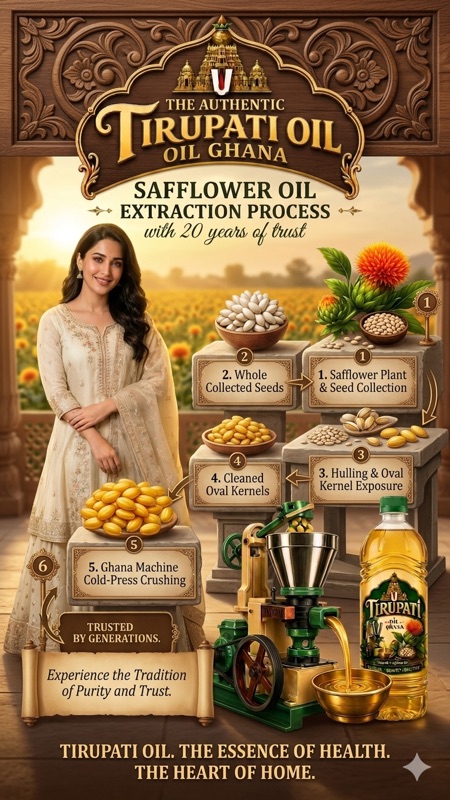
For over 20 years, Tirupati Oil Ghana has been dedicated to producing pure safflower oil using traditional methods that prioritize quality, freshness, and authenticity. Every drop of our oil goes through a carefully managed process—from seed selection to oil extraction—ensuring the natural goodness of safflower reaches your kitchen.

Step 1: Safflower Plant & Seed Collection

Everything begins in the fields, where healthy safflower plants are cultivated and harvested at the right stage of maturity. Only high-quality safflower seeds are collected to ensure premium oil production.

Using quality raw materials is the first step toward producing natural safflower oil with consistent taste and quality.

SEO Keywords: safflower plant, safflower seed collection, premium safflower seeds.


Step 2: Whole Safflower Seeds

After harvesting, the whole safflower seeds are carefully sorted to remove damaged or immature seeds. This selection process helps maintain the purity and consistency of the final product.

Healthy seeds are the foundation of traditional safflower oil.

SEO Keywords: whole safflower seeds, pure safflower seeds, quality safflower seeds.


Step 3: Hulling & Kernel Exposure

The outer shell of each safflower seed is gently removed to expose the inner kernel. This process helps prepare the kernels for efficient oil extraction while maintaining their natural quality.

Proper hulling ensures that only the best kernels move to the next stage of production.

SEO Keywords: safflower kernel, seed hulling process, safflower oil manufacturing.


Step 4: Cleaned Oval Kernels

The exposed kernels are thoroughly cleaned to remove any remaining impurities. Clean kernels contribute to producing high-quality edible safflower oil that families can trust.

Maintaining cleanliness throughout the process is one of the reasons customers choose Tirupati Oil Ghana.

SEO Keywords: cleaned safflower kernels, edible safflower oil, natural cooking oil.


Step 5: Traditional Ghana Machine Pressing

The cleaned kernels are processed using our traditional Ghana oil machine. This method has been trusted for generations and allows us to produce pure safflower oil using a slow and careful extraction process.

For over 20 years, Tirupati Oil Ghana has proudly preserved this traditional oil-making practice, combining experience with a commitment to quality.

SEO Keywords: Ghana pressed safflower oil, traditional oil extraction, pure safflower oil, Tirupati Oil Ghana.


Step 6: Trusted by Generations

After extraction, the oil is prepared and packed with care before reaching your home. Every bottle reflects our dedication to traditional craftsmanship, consistency, and customer satisfaction.

For more than two decades, families have trusted Tirupati Oil Ghana for its commitment to producing natural safflower oil using authentic methods.


Why Choose Tirupati Oil Ghana?

✔ 20+ Years of Trusted Experience

✔ Traditional Ghana Pressed Extraction

✔ Carefully Selected Premium Safflower Seeds

✔ Hygienic Manufacturing Process

✔ Pure & Natural Safflower Oil

✔ Trusted by Families Across Karnataka


Experience the Tradition of Purity and Trust

At Tirupati Oil Ghana, we believe that quality begins with the seed and ends with your satisfaction. Our traditional safflower oil extraction process reflects decades of experience, honest craftsmanship, and dedication to producing oil that families can rely on every day.

If you’re looking for pure safflower oil, traditional Ghana-pressed oil, and a brand with over 20 years of trusted experience, Tirupati Oil Ghana is proud to serve your family with the essence of health and the heart of every home.


https://www.tirupatioilghana.in/2026/07/history-of-safflower-oil-from-ancient.html